
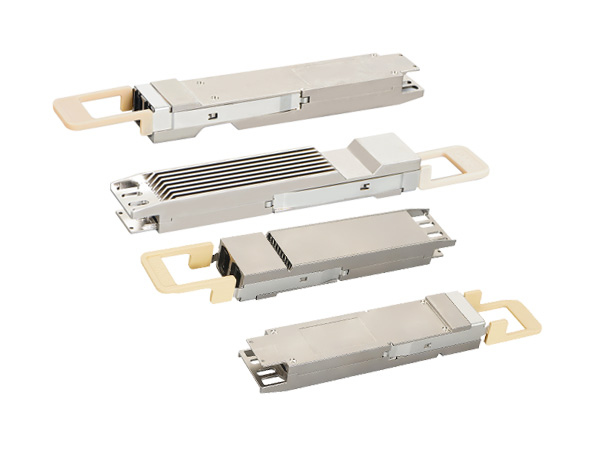
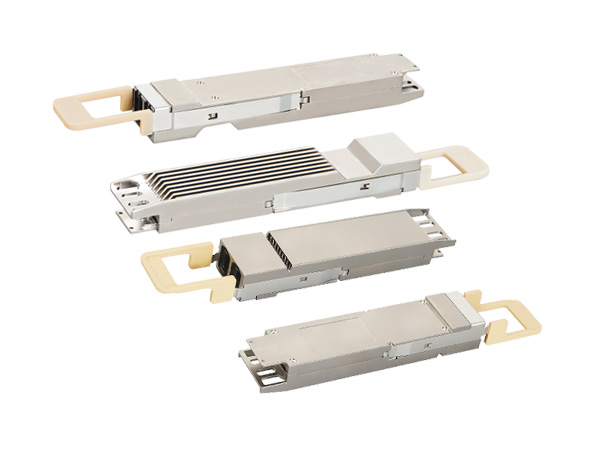
Optical module structural parts
Optical module structural parts
I. Special Environment Applications: Customized design adapted to extreme conditions
Aerospace and military communications
Application scenarios: High-speed data transmission on platforms such as satellites and aircraft.
Structural component requirements
Radiation-resistant reinforcement: Utilizing special materials and packaging processes, it can resist cosmic rays or electromagnetic pulse interference.
Lightweight design: Reduce weight through ceramic or composite material shells to meet the payload limitations of spacecraft.
Industrial Automation and Smart Grid
Application scenarios: Real-time data transmission in factory automation equipment or power monitoring systems.
Structural component requirements
High electromagnetic compatibility (EMC) : Through metal shielding covers and filter circuits, it suppresses electromagnetic noise in industrial environments.
Wide operating temperature range: Supports operating temperature from -40℃ to 85℃, suitable for outdoor or high-temperature workshop environments.
Ii. Emerging Technology-Driven: Future Applications of Optical Module Structural Components
AI and High-Performance Computing (HPC
Application scenario: High-speed interconnection between GPU clusters (such as NVLink alternative solutions).
Structural component requirements
Ultra-low latency: By optimizing the optical path design and signal processing algorithms, the latency is controlled at the nanosecond level.
High bandwidth density: Equipped with 800G/1.6T modules and MPO connectors, it supports dense deployment of 144 fiber cores per inch.
Photon computing and quantum communication
Application scenarios: High-speed interconnection between photonic chips or quantum key distribution (QKD).
Structural component requirements
Single photon detection: Integrated SPAD (Single Photon Avalanche Diode) array to achieve highly sensitive photon counting.
Precision optical alignment: By adjusting the optical path through micro-electromechanical systems (MEMS), single-photon-level coupling accuracy is ensured.
Iii. Technological Trends in the Application of Optical Module Structural Components
Integration and silicon photonics technology: By integrating components such as lasers and modulators onto silicon-based chips on a single chip, the module size is reduced and costs are lowered. For instance, Intel's 100G silicon photonics module has already achieved mass production.
CPO (Optoelectronic Co-Packaging) : By co-packaging the optical engine and the switching chip, it shortens the transmission distance and reduces power consumption. It is expected to become a mainstream technology after 2025.
Pluggability and standardization: Promote open standards such as QSFP-DD and OSFP, break supplier lock-in, and facilitate collaborative innovation throughout the industrial chain.
Ding Dong:+86 136-2094-9831


Douyin
Copyright © 2025 Dongguan Laoyou Hardware Products Co., Ltd. All rights reserved
The webpage materials and related resources of this site are all from the Internet. If there is any infringement, please inform us immediately and we will delete it within 24 hours.
