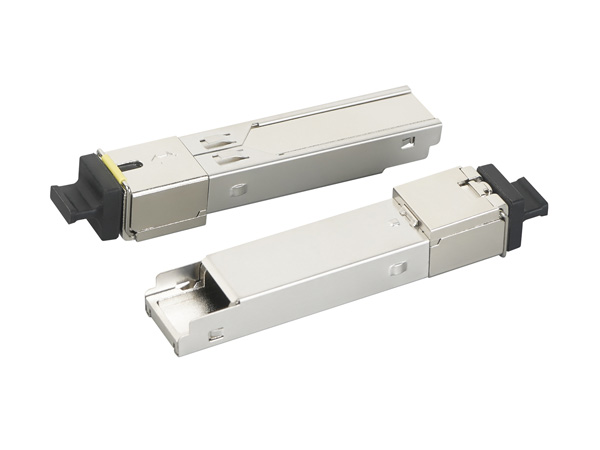
Optical module structural parts
Optical module structural parts
As the core component of optical fiber communication, the structural design of optical modules needs to take into account the photoelectric conversion efficiency, signal integrity and environmental adaptability. The following are the key components of optical module structural parts and their functional analyses:
I. Core photoelectric conversion Components
Optical Emission Assembly (TOSA
Laser (LD) : It uses semiconductor lasers (such as DFB, VCSEL) or light-emitting diodes (LED) to convert electrical signals into modulated optical signals. For instance, 1310nm lasers are used for long-distance transmission, while 850nm VCsels are employed for short-distance multimode fibers.
Drive circuit: Controls the bias current and modulation current of the laser to ensure stable output of optical power. For instance, power fluctuations caused by temperature changes can be compensated through an automatic power control (APC) circuit.
Optical structure: including lenses, isolators, etc., focusing the light beam and preventing reflected light from interfering with the stability of the laser.
Optical receiving component (ROSA
Photodetector: It adopts PIN photodiodes or avalanche photodiodes (APD) to convert optical signals into electrical signals. APD enhances sensitivity through an internal gain mechanism and is suitable for long-distance transmission.
Preamplifier: Amplifies weak electrical signals and reduces noise to ensure signal integrity. For instance, a transimpedance amplifier (TIA) converts current signals into voltage signals.
Optical filter: Filters stray light, reduces noise interference, and improves the signal-to-noise ratio.
Ii. Functional Circuits and Interfaces
Digital Diagnostic Circuit (DDM
It integrates a microcontroller (MCU) and sensors to monitor the temperature, voltage, optical power and other parameters of the optical module in real time, and reports them to the host system through the I2C interface, supporting fault prediction and remote management.
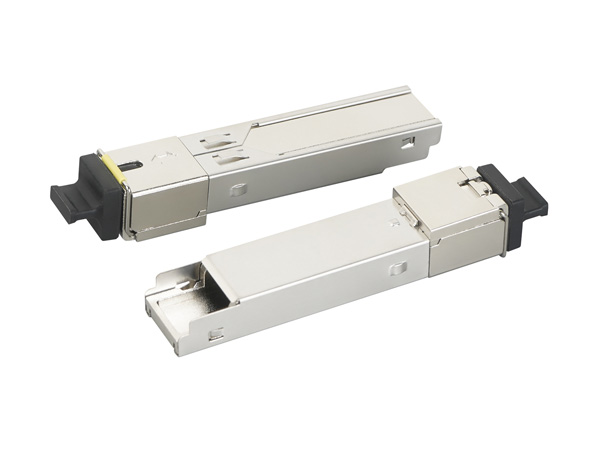
Electrical interface
Gold finger: It adopts high-speed electrical connectors (such as the 30-pin interface of SFP+) to achieve electrical connection with the motherboard. It is necessary to meet the requirements of high-speed signal transmission, such as impedance matching and low crosstalk.
Hot-swapping control: Through a soft-start circuit and power management chip, it supports the live plugging and unplugging of optical modules, preventing equipment damage caused by power surges.
Optical interface
Optical fiber connector: It adopts standard interfaces such as LC and MPO to achieve physical connection with optical fibers. For instance, the MPO interface supports multi-core optical fiber parallel transmission and is suitable for 400G/800G high-speed modules.
Ceramic sleeve: High-precision ceramic sleeves ensure the alignment accuracy of optical fibers and reduce insertion loss (usually <0.2dB).
Iii. Structural Supports and Protective Components
Shell and base
Material: Metal (such as zinc alloy) or high-strength plastic is adopted to provide electromagnetic shielding (EMI) and mechanical protection. For instance, the QSFP-DD module adopts a metal casing to meet the requirements of heat dissipation and shielding.
Heat dissipation design: Optimize thermal management through heat sinks, thermal pads or liquid cooling channels to ensure the stable operation of the laser in high-temperature environments. For instance, the power consumption of a 400G optical module can reach 15W, and an efficient heat dissipation design is required.
Locking mechanism
Snap-on or threaded locking: Prevents the optical module from loosening in a vibrating environment and ensures long-term reliability. For instance, the SFP module adopts a sliding snap-on design, supporting quick plugging and unplugging.
Sealing part
Silicone ring or sealant: Achieves IP67 dust and water resistance, suitable for harsh outdoor environments. For instance, industrial Ethernet optical modules need to pass the temperature cycle test ranging from -40℃ to 85℃.
Iv. Special Application Structural Components
Wavelength Division Multiplexing (WDM) component
Filter plates or gratings: To achieve the combining and splitting of multi-wavelength signals in CWDM/DWDM modules. For instance, the DWDM module supports 16/32 wavelength multiplexing, with a single wavelength interval as small as 0.8nm.
Coherent optical component
Coherent modulators: Implement high-order modulation formats such as QPSK and 16QAM in coherent optical modules to enhance spectral efficiency. For instance, the 400G coherent module adopts silicon photonics integration technology, reducing its size and lowering its cost.
Tunable laser
MEMS or thermal tuning structure: Supports dynamic wavelength adjustment, suitable for flexible optical networks (Flex Grid). For instance, tunable DBF lasers can cover the C-band (1530nm to 1565nm).
V. Trends in Structural Component Design
Miniaturization and high density: From SFP to QSFP-DD, the package size has been reduced by more than 50%, and the port density of a single module has increased by four times.
High speed and low power consumption: By adopting PAM4 modulation technology, the single-channel rate has been increased from 25Gbps to 50Gbps, while reducing the energy consumption per bit.
Integration and silicon photonics technology: By integrating silicon photonics, components such as lasers and modulators are integrated on a single chip, reducing packaging steps and lowering costs. For instance, Intel's 100G silicon photonics module has already achieved mass production.
Ding Dong:+86 136-2094-9831


Douyin
Copyright © 2025 Dongguan Laoyou Hardware Products Co., Ltd. All rights reserved
The webpage materials and related resources of this site are all from the Internet. If there is any infringement, please inform us immediately and we will delete it within 24 hours.